
In 2019, the metric for success in IT was the pace of hiring. In 2026, those metrics are a thing of the past. Today, the market is undergoing a “Great Reset” – we are moving away from building giant organizational structures toward high talent density and real business value. In the face of market uncertainty and cost pressures, the critical question is no longer “how many developers do we need?” but “how do we wisely manage the ones we have?”
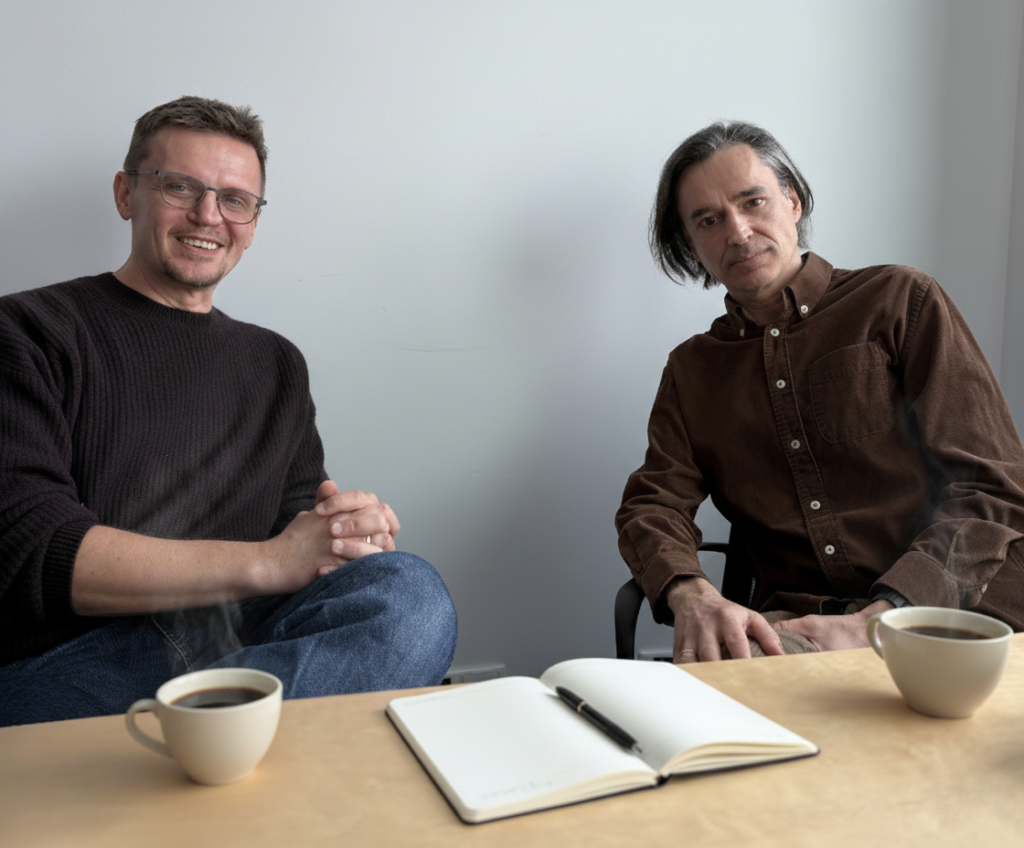
To discuss how to wisely build teams today – in an era of optimization and the AI revolution—we speak with Tomek Kornaś, Head of Ocado Technology – Poland.
Bartek: Tomek, it is often repeated that the pandemic was a test of logistical agility. You argue that the real fight for business model survival is happening right now. What do you mean by that?
Tomek: The pandemic was difficult, but it was largely about the organization of work: how to transition to remote work, how to maintain business continuity, and how not to lose touch in communication. What is happening today, however – especially with AI, pressure on margins, and general market uncertainty – is a deeper shift. It forces us to question meaning and effectiveness: does the way we work, how we build products, and how we develop people fit into the world of 2026? This is no longer a correction. This is a reset.
Bartek: Do you remember 2019? The office was buzzing with life, and we measured success by the number of new hires per month. Today, those metrics seem to belong to a different era. From your perspective, how has the foundation of management changed – from controlling “inputs” (who is in the office) to accounting for “outputs” (what we actually delivered)?
Tomek: This is one of the biggest changes. In 2019, it was easy to get carried away by the idea that growth itself was the measure of success: more people, more teams, more projects. The problem is that in IT, value does not scale linearly with headcount. Every additional person increases not just what I call execution potential, but also the cost of coordination. The number of dependencies grows, the number of decision points multiplies, and the communication overhead rises. At some point, the organization’s energy starts going into synchronization instead of value creation.
You can do an immense amount of operational work, have full sprints and tightly packed roadmaps, and yet still fail to improve the customer experience or product stability. That is why we are shifting more heavily from activity metrics to impact metrics. We no longer just ask how much we delivered, but whether the customer actually felt an improvement, whether we solved a specific business problem, and whether we can deliver predictably without an exponential increase in structural costs.
Bartek: What about building trust when you don’t see each other at the coffee machine every day?
Tomek: Relationships are the foundation of any workplace environment, and that hasn’t changed. Only the context has. We can no longer assume that relationships will “just happen” because we bump into each other daily. In a hybrid or remote model, trust doesn’t happen by accident – it has to be designed.
In practice, trust is built through predictability of behavior and consistency in decisions. People need to know what to expect from one another. If we declare priorities and then change them without explanation, trust erodes faster than it would in an office-centric model. If we promise support, and it’s nowhere to be found in moments of high tension, trust ceases to be a real asset.
Coffee and beer are nice, but they don’t build structural trust. That is born from keeping your word, honest feedback, and transparency of goals. Moreover, trust isn’t just the glue that holds teams together. It is a mechanism for reducing coordination costs. In high-trust organizations, decisions are made faster, less control is needed, fewer layers of oversight exist, and less energy is spent on hedging against risks.
Bartek: For years, the IT market was fueled by relentless growth. Today, investors and boards are calling for a reality check. What matters now is whether every single decision makes sense. How has this shift affected budgets and planning?
Tomek: Companies think twice today before hiring someone for a specific role, and three times before even opening it. This isn’t a lack of courage; it’s a greater awareness of systemic costs. IT is not an assembly line. At a certain point, adding people lowers efficiency per capita because organizational complexity balloons. The question is no longer “do we need more hands on deck?” but “will this role increase our talent density and our ability to make better decisions?” That’s why we are moving toward “hiring smartly” instead of “hiring more” – quality over quantity.
There is also a clear shift in investment from additional headcount to competencies and tools, particularly those related to AI. A well-prepared engineer who knows how to intentionally leverage AI tools doesn’t just work faster. They alter the very structure of their work. They delegate repetitive fragments to agents, while they themselves focus on architecture, quality, and systemic consequences. This isn’t just an increase in productivity; it’s an increase in agency.
Bartek: You mentioned planning. Has the approach to roadmaps changed?
Tomek: Definitely. A roadmap cannot be a wish list or a tool to appease stakeholders. In a world of constrained resources, the greatest danger isn’t low velocity – it’s a lack of focus. Therefore, an ordered backlog based on real business priorities must come first. Only then does the roadmap derive from it. Strategy in 2026 is much more about selection than about maximising scope.
Bartek: It is often said that the pandemic was just a warm-up. Today, we face “Crisis 2.0”: AI displacing repetitive tasks, pressure on margins, and market uncertainty. What kind of resilience do you demand from managers today that they didn’t need in 2019?
Tomek: A manager must accept that change is no longer a transformation project with an end date. It is a systemic state. You have to build AI competencies before they become a blindingly obvious standard, teach your team to work with tools that aren’t perfect yet, and make investment decisions without guarantees of an immediate return.
In large organizations where the codebase spans millions of lines, AI does not deliver spectacular results overnight. But ignoring this shift is strategically riskier than experimenting. If you wait until “everyone else is already doing it,” it will be too late.
That’s why I don’t treat AI as a “magic wand for tomorrow,” but as an investment. An investment in competencies, good practices, and working standards. Not everything will pay off immediately, but a failure to invest will absolutely yield negative returns.
Bartek: And what about team anxiety? How do you manage the fear of being replaced?
Tomek: The worst thing you can do is pretend the elephant isn’t in the room. AI competencies will become a part of practically every job description. Individuals who learn to expand their agency through AI will be more valuable than before. Those who ignore this shift risk losing their edge. This is not about eliminating humans; it’s about redefining their role within the system.
Given this breakneck pace of change, continuous learning is more vital today than ever. Those who hop on this train will be incredibly valuable, and they won’t run out of work. Those who lag behind may find themselves forced to look for a different role.
Bartek: The thesis goes that seniority today is about adaptability, not years of service. How do you redefine the concept of a “Senior”?
Tomek: Years of service have never been a guarantee of quality for me. In a world of such rapid technological disruption, I define seniority operationally as the speed of adaptation and the quality of decisions made in an unfamiliar environment. A senior is someone who rapidly grasps a new technology, can anchor it within a systemic context, and can foresee the architectural and business consequences of their choices.
If someone has been doing the exact same thing for 10 years, they might be an expert in an area that has ceased to be strategic. In 2026, a senior is not a historical archive of knowledge. A senior is an accelerator of change.
Bartek: Kraków has stopped being cheap. How do you pitch a Kraków-based team to a global board when the “low-cost” card is no longer on the table?
Tomek: I am in the comfortable position where today, I no longer have to pitch teams from Kraków or Wrocław to anyone. Over Ocado’s 12-year presence in Poland, we have proven that we compete on quality, not price. Thanks in part to itMatch, we managed to keep our recruitment bar exceptionally high – almost as if we knew that a time would come when exceptional talent would be paramount.
But we are not resting on our laurels. We intentionally invest in upskilling, and we do it through more than just traditional, course-based methods. Our community and the people who are first to test new approaches play a huge role. Just last week, I had the opportunity to observe a highly intensive, two-day AI training session led by Sławek Radzymiński, who has been experimenting with an agentic approach to coding for a long time. This wasn’t a presentation of tools; it was hands-on, practical work on real-world problems. In the open market, such workshops would cost several thousand PLN, but here they are a staple of our internal learning culture.
I also see consistent efforts toward building an engineering-and-product mindset, thanks to the work of Konrad Wadas and Paweł Stobiecki, among others. This approach genuinely shifts the teams’ mindset from “completing tasks” to solving problems that actually matter. We no longer focus solely on implementing tickets, but on understanding the business context and user needs, asking the right questions (“why?”, “for whom?”, “to what end?”), and taking ownership of whether the final outcome truly works and makes sense. It is becoming increasingly vital for us not just what we deliver, but whether it brings real value.
As a company, we actively support these initiatives by building communities around our meetups, Product Peak and techBytes. We share knowledge both internally and externally. We don’t just develop competencies within our own walls; we demonstrate how this approach can be effectively implemented.
And that is exactly what defines a “Premium Hub” today. We are not a code factory or an execution team working strictly to specification. We are autonomous product teams capable of collaborating with the business, understanding the product, conducting research, translating insights into architectural decisions, and delivering value quickly. In a world where baseline technological productivity is leveling out, it is this business maturity and pace of learning that build a real competitive advantage.
The conversation with Tomek Kornaś leaves no room for illusion: the 2026 IT market demands absolute honesty from leaders regarding their own processes and costs. At itMatch, we have never been just a “CV vendor”; we are a partner that shares responsibility for team building. In the era of “The Great Reset,” this approach becomes even more critical – today, an agency is primarily about supporting accurate hiring decisions and managing efficiency.
At itMatch, we support this transformation by relying on hard facts coming straight from the market:
Market mapping: In times of cost pressures, we provide hard data on rates and specialist availability, helping you make the decision to open a role only when it stands a real chance of success.
Selection based on logic and experience: We eliminate guesswork by verifying a candidate’s ability to adapt quickly and deliver results.
Optimizing leaders’ time (High Accuracy): Thanks to our high accuracy rate (90% of our candidates move on to subsequent interview stages), management only gets involved in recruitment when real talent is on the table.
Transparency in uncertain times: We act as a “chaos filter.” We provide regular reports and market feedback, giving you hard data for discussions with the board about what is actually working and what needs adjustment in your hiring strategy.
In 2026, Kraków and Poland are hubs of business maturity, not just technological skill. If your company is facing the challenge of optimizing its team for new goals – let’s talk about how to do it wisely and without sacrificing quality.
About the authors:
Interviewer: Bartek Toporkiewicz – CEO of itMatch, an expert in building strategic recruitment partnerships and scaling IT teams based on hard market data.
Interview Guest: Tomek Kornaś – Head of Ocado Technology – Poland, a leader with many years of experience in managing autonomous product teams and implementing modern engineering models.